
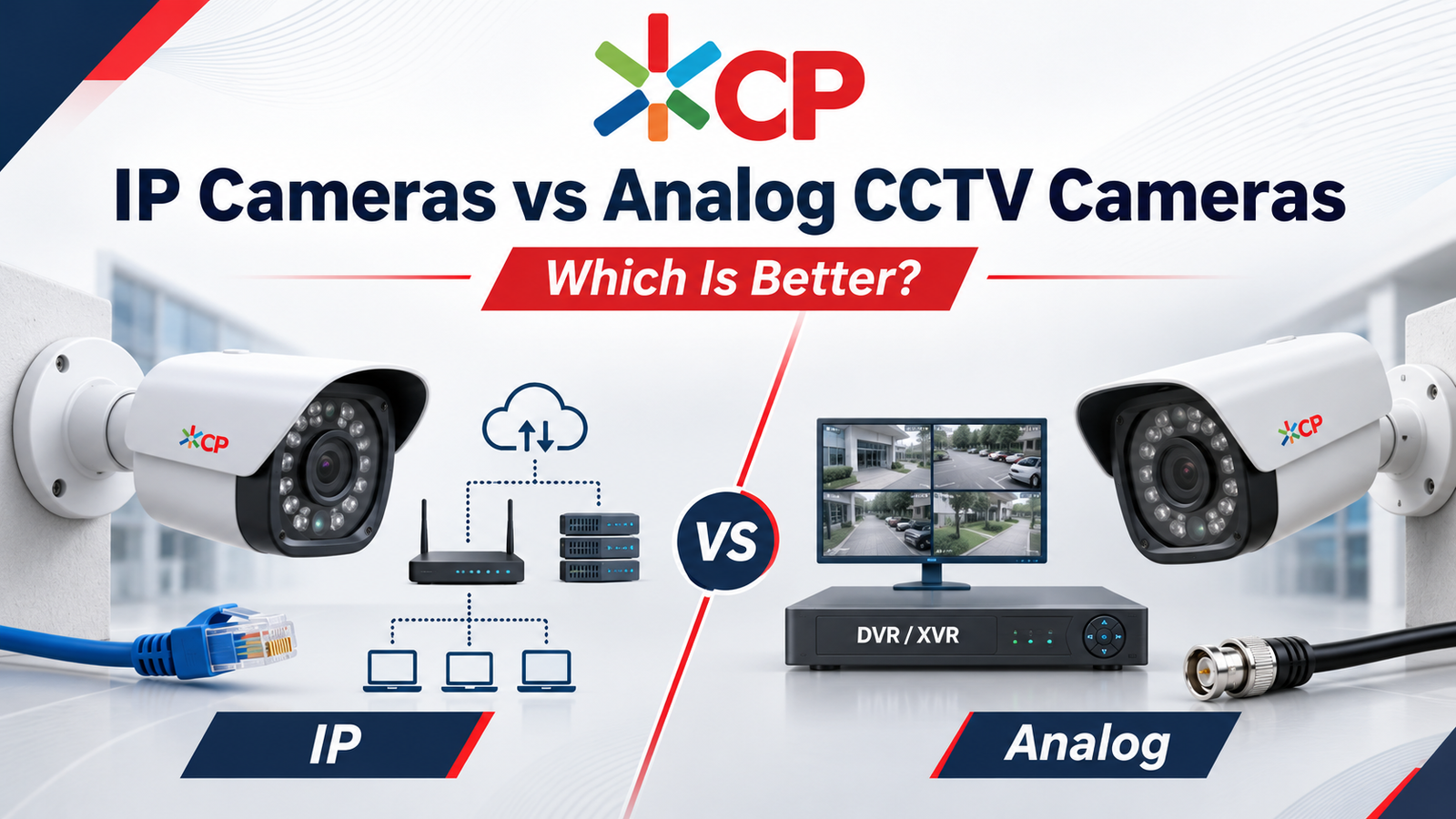
Choosing between IP cameras and analog CCTV cameras is one of the most important decisions when planning a surveillance system. The right answer depends on your existing cabling, image-quality needs, budget, recording setup and plans for future expansion. This comparison explains both technologies without treating modern HD analog CCTV as outdated.
What is an IP CCTV camera?
An IP (Internet Protocol) camera converts video into digital data inside the camera and transmits it over a local computer network. Many professional IP models connect by Ethernet cable to a network video recorder (NVR), server or video-management system. Compatible devices may use Power over Ethernet (PoE) to carry both electricity and data over one Ethernet cable. Other IP cameras use WiFi or dedicated power. Internet access is not inherently required for all local IP recording systems.
IP cameras can be especially useful when a site needs network integration, flexible recording, centralized management, higher-end analytics or a system designed to scale over time. However, smart features and interoperability vary by camera and software—not every IP camera includes every function.
What is an analog CCTV camera?
An analog CCTV camera sends video over a compatible coaxial connection to a DVR or XVR recorder, which processes and stores footage. Traditional analog systems were associated with low resolution, but today’s HD-over-coax formats can deliver detailed, high-definition images. Supported formats and resolutions depend on the camera, recorder and signal standard.
For example, the CP+ catalog includes the CP-500B outdoor bullet camera and CP-100D dome camera, both advertised as full-color coaxial-audio models. Check their official technical documentation before finalizing resolution or recorder compatibility, as some historical product image filenames and page titles are inconsistent.
IP vs analog CCTV: comparison at a glance
| Factor | IP CCTV cameras | Modern analog HD CCTV cameras |
|---|---|---|
| Video transmission | Digital data over IP network | Analog/HD signal over compatible coaxial cable |
| Recording | Usually NVR, VMS or supported local/cloud storage | Usually DVR or XVR |
| Typical cable | Ethernet for wired systems | Coaxial cable, often with separate power |
| Power | PoE on compatible wired equipment or separate supply | Typically separate supply; other powering standards exist |
| Image quality | Wide range of resolutions and image processing features | Modern HD-over-coax can also offer high resolution |
| Smart features | Often broader network analytics and integration options | Some advanced features available; varies by model/recorder |
| Expansion | Potentially flexible with suitable network capacity | Depends on available XVR/DVR channels and cabling |
| Cybersecurity | Requires network and device hardening | Connected recorders also require cybersecurity controls |
| Good fit | New network-oriented or larger integrated installations | Cost-conscious upgrades using existing suitable coax cables |
1. Image quality: does IP always look better?
No. A camera’s usable picture depends on much more than whether it is IP or analog. Resolution, sensor size, lens, field of view, exposure, compression and lighting all matter. Modern HD-over-coax cameras can produce detailed images that meet many home and business requirements. Meanwhile, IP systems offer a broad choice of models, including high-resolution and specialized network cameras.
Your actual goal should be recognizable detail at the right distance. A wide-angle 8MP image may be less useful for identifying a person far away than a correctly positioned lower-resolution camera with an appropriate lens. For camera placement guidance, read How to Choose the Right CCTV Camera for Your Home or Business.
2. Cabling and installation: Ethernet vs coaxial
IP systems: Professional wired IP cameras typically communicate over network cabling, with PoE simplifying installation where supported. A proper design must account for Ethernet cable runs, switch capacity, PoE power budgets, network bandwidth, surge protection and network reliability.
Analog systems: Coaxial infrastructure can be valuable if a building already has suitable cable routes. An upgrade to compatible HD-over-coax cameras and an XVR may avoid extensive rewiring. The existing cabling should still be tested: damaged connectors, unsuitable cable, insufficient power and unsupported video standards can cause problems.
Wireless IP cameras are not automatically cable-free: many still require a power cable, and WiFi signal strength can change with building materials or interference. Choose the installation approach based on the building, not advertising alone.
3. DVR vs NVR vs XVR: which recorder do you need?
DVR (Digital Video Recorder): Commonly records analog camera signals. NVR (Network Video Recorder): Commonly records digitally encoded video from compatible IP cameras. XVR: A flexible recorder category that can accept multiple supported analog formats; some models also support selected IP camera channels, but compatibility and channel limits must be checked model by model.
The CP+ XVR-108S 8-channel recorder is one example on this website. It is not evidence that an arbitrary IP camera will work with it: verify supported inputs, firmware and network-channel capacity before purchasing or combining equipment.
4. Installation cost and total ownership cost
For properties with existing usable coax wiring, an HD analog upgrade can often be an economical option. For a new construction project, a suitable IP/PoE installation may reduce separate power runs and enable future integration. Neither system is always cheaper: costs depend on camera count, cabling, labor, switches, recorder, storage drives, network configuration and ongoing support.
Build a quotation for the whole system rather than comparing two camera prices. Include retention requirements, backup power, warranties, maintenance and any cloud or mobile-data charges. The less expensive camera is not necessarily the less expensive surveillance system.
5. Smart detection, remote access and cybersecurity
IP systems frequently offer a wide range of video analytics and integration options, such as line-crossing rules, person detection, object classification or management across sites. But these capabilities depend on the exact camera, licenses and recording platform. Modern XVR systems can also provide app access and certain intelligent features, so avoid assuming analog means no smart functions.
Both technologies need security controls once their recording equipment or cameras connect to a network. Change default passwords, update supported firmware, limit user permissions, protect remote access and restrict devices from unnecessary internet exposure. For business networks, isolate CCTV equipment where practical and record who can access footage.
6. Reliability, maintenance and the UAE environment
Reliable surveillance comes from sound equipment selection and installation. A local analog recorder may continue recording if the internet goes down; so can a properly configured local IP/NVR system. But either can stop recording during a power failure without backup power. Network-based installations also depend on correctly configured switches and cabling.
In Dubai and elsewhere in the UAE, consider heat, dust, glare and outdoor exposure. Check each model’s operating-temperature and ingress-protection specifications; a dome, bullet or PTZ housing style alone does not guarantee outdoor suitability. Clean lenses appropriately, inspect connectors and review recorded footage periodically to catch faults before an incident.
When should you choose IP CCTV?
An IP system may be the better fit when you are starting a new installation, need network video management, expect expansion to many cameras, want more advanced analytics or need to integrate cameras with other networked security systems. Confirm your network can handle the intended video load and that your chosen NVR or video-management platform supports all devices.
When should you choose analog HD CCTV?
HD-over-coax can be a strong choice when you already have reliable coaxial cabling, need a straightforward system for a villa or shop, and want to control installation costs without sacrificing necessary coverage. The CP+ CP-400B panoramic bullet camera and CP-200DP mini PTZ dome illustrate the range of HD-compatible products listed in our catalog, subject to matching the appropriate recorder and signal format.
Which CCTV system is best for a home, shop or warehouse?
Apartment or small villa: Assess the number of entrances and whether there is pre-existing wiring. A simple compatible analog or IP setup may be sufficient.
Retail shop: Both can serve cashier zones, entrances and aisles. Prioritize coverage and the ability to retrieve recordings quickly.
Office: An IP system can offer integration and easier management if network infrastructure already exists.
Warehouse or multi-building facility: Network systems may be useful for scale and centralized management, but a hybrid or upgraded analog design can sometimes be practical when substantial cabling is already installed.
Can you combine IP and analog cameras?
Sometimes. A compatible hybrid recorder, video encoder or network video system can bridge older analog cameras with selected IP functionality. This requires a deliberate compatibility check—not every XVR, camera or software package supports every configuration. Before migrating, document your existing cameras, cable routes, recorder input formats, power supplies and required retention period.
Frequently asked questions
Do IP cameras work without the internet?
Yes, many IP cameras and NVR systems can record over a local network without a public internet connection. Remote viewing or cloud features may need connectivity.
Are analog CCTV cameras outdated?
No. Old standard-definition analog systems are limited, but modern HD-over-coax systems remain useful for many residential and commercial installations, especially when existing coaxial wiring can be reused.
Can an analog CCTV camera connect to an NVR?
Usually not directly. A compatible video encoder or specifically supported hybrid equipment may be required. Always check the manufacturer’s specifications.
Is an 8MP camera automatically better than 5MP?
No. Lens selection, mounting position, lighting, sensor performance and recording settings all affect image quality and usable detail.
What is the best choice for my UAE property?
There is no universal winner. For an existing wired shop, HD analog may be economical; for a new networked office or larger facility, IP may be preferable. Local installation requirements and any applicable regulatory obligations should be checked for the specific site.
Explore CP+ CCTV equipment and get a system recommendation
Choosing between IP and analog CCTV is easier when you start with the site layout, required camera views and recording duration. Explore the CP+ CCTV Security product catalog, including the four-channel camera kit, or contact our team with your installation details. For more help deciding on placement and features, see our UAE home CCTV buying guide.
Further reading
For technical background on network video and upgrading analog installations, see Axis Communications: Video Encoders and Axis Communications: The Network Video Way.